Connections: configure reusable access without exposing credentials
A Connection separates reusable endpoint metadata, authentication method and credential custody from a Mapping operation. The selected connector determines the fields and methods shown; the worker must still have the required driver, network path and identity permissions. Catalog presence is not proof of configured access.
Prepare a read-only laboratory endpoint, an authorized authentication method and a compatible worker. Keep secrets in the supported custody flow. Use synthetic names and endpoint placeholders in documentation; avoid placing values or secret references in a screenshot.
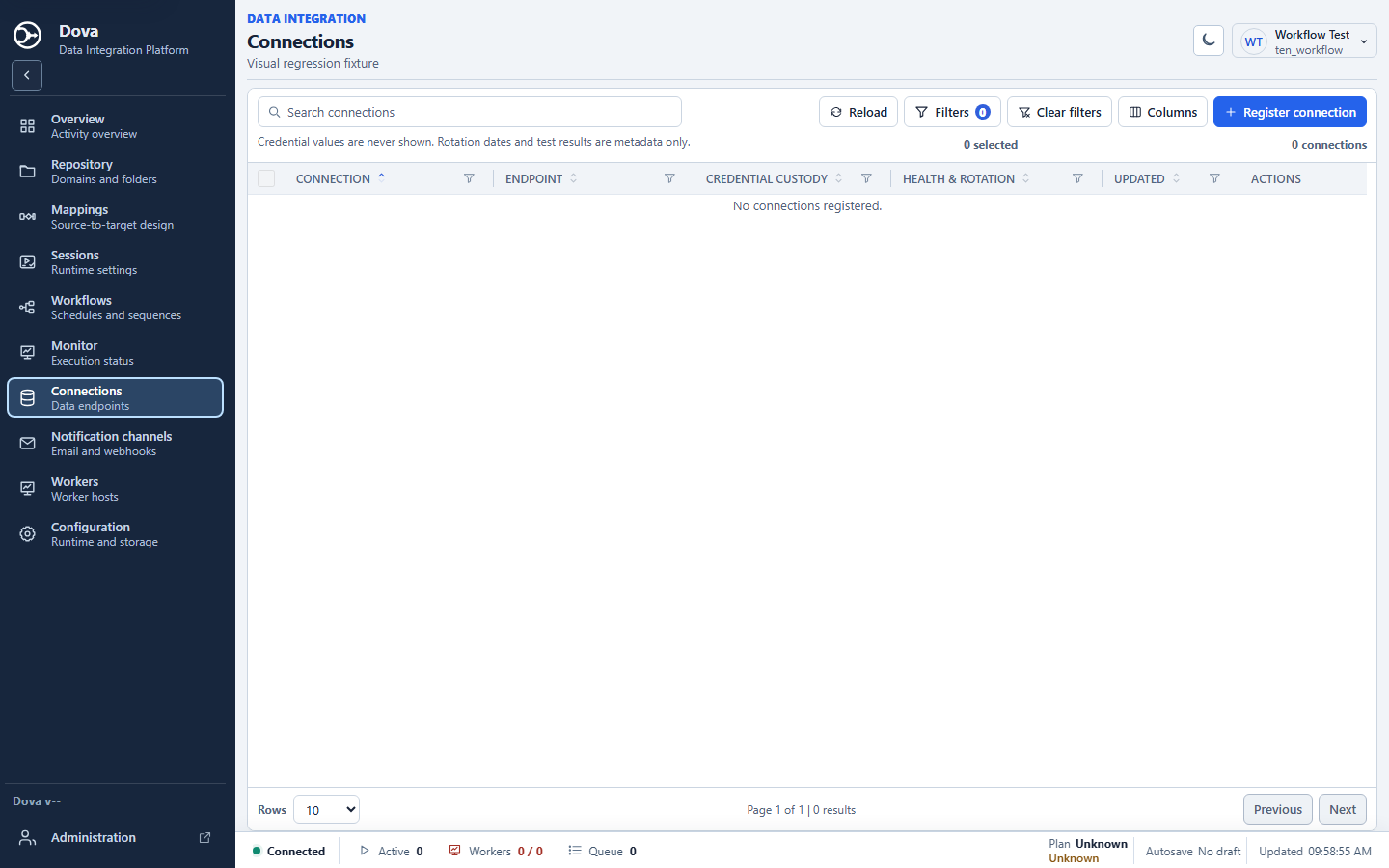
Dova 7 Connections, desktop light theme. All displayed metadata belongs to a synthetic local fixture.
Step-by-step procedure
Select the connector. Open Connections and start the creation action allowed to your role. Select the intended connector and inspect its required fields. A database name, project identifier and HTTP path are different metadata even when they are all text.
Enter endpoint metadata. Provide an authorized host or HTTPS endpoint, port and connector-specific database/schema or resource information. Use the provider-specific defaults only as a starting point and confirm them with your environment owner.
Choose custody and authentication. Select the supported custody mode and one of its valid methods. Passwordless uses a runtime identity; a customer vault uses a protected reference; other protected flows collect values without redisplaying them. Do not force a hidden method into the form.
Complete the protected input. Follow the credential or enrollment instructions for the chosen method. Confirm the principal has only the resource permissions needed for the sample. A syntactically valid reference does not prove that a worker can resolve it.
Save and inspect. Review the label, tenant, connector, endpoint metadata and custody method, then save. Return to the inventory and inspect the persisted record. Metadata editing, credential rotation, testing and revocation have different effects.
Test the intended path. Use Test for the saved Connection and read the safe result. Then perform a small read-only extraction through a Mapping/Session on the compatible worker. A connection test does not certify every read, write or recovery mode.
Verify and maintain. Compare the small output with an independent expected result. Record the Connection identifier and relevant method without values. Review dependencies before revocation; rotate credentials through the supported action when needed.
Verify the result
For acceptance, a saved Connection exposes only permitted metadata, the test gives the expected safe status, and a small authorized extraction produces the expected rows. Consult the connector matrix for declared methods and metadata. File server protocol matters: SFTP uses SSH, while FTP is not an encrypted transport.
Errors and recovery
For authentication failure, inspect method, custody, principal permissions and expiry. For network failure, inspect DNS/endpoint, TLS and worker egress. For a missing driver, check installed worker capabilities. Keep errors safe; avoid pasting vault references or credentials into descriptions to make a failed form easier to debug.
Continue
Repository · Mappings · Sessions · Workflows · Monitor · Configuration.